
Moral Development and Empathy
- tawni sandy
- Jan 20, 2024
- 5 min read

Creating a Positive Learning Environment
Written by Tawni Sandy

In my research to find developmental theories I can draw from to create a positive classroom environment for early child learners, I came across two schools of thought I had never encountered before. Kohlberg’s theory of moral development and Hoffman’s theory of empathy development.
Social emotional learning (referred to as SEL) is the practice of developing self-awareness, self-control, and interpersonal skills that are crucial for success in school, work, and life (cfchildren.org).
SEL is an important piece to creating a positive learning environment for our students. When we set up our classrooms to be a safe and orderly place to learn, students can better focus on discovering new concepts and building relationships with their peers.
Part of creating a safe and healthy learning environment is creating class norms and rules to be followed and setting the expectations of the students clearly, teaching them the correct way to behave in class. This leads us to exploring the theory of moral development.
Moral Development
There are six stages of moral development in three subgroups: Preconventional (ages 3-7), Conventional (ages 8-13), and Postconventional (adulthood) as seen below.

Image from SimplyPsychology.org
Since we are looking at our early learners, let’s focus on the preconventional stages of moral development which are to be motivated by avoiding punishment and self-interest. This means that children are motivated to conform to the rules, consequences, and rewards set by an authority figure. In this way morality for young children is seen as merely acting out of fear of punishment or the drive to be rewarded for being good. Little Johnny is going to resist the temptation to take Sally’s snack because he knows it is against the rules and he will lose recess time for his behavior. Sally is going to help pick up trash on the school yard because she knows if she does so, and the teacher sees her, she will get a candy.
While these are important factors in helping children develop morally, I think there is something missing from this theory.Empathy.
Empathy
Can a kindergartener genuinely be motivated by empathy for others? Yes, I believe they can.
Empathy is something that can be modeled, taught, and intentionally fostered in even the youngest of children. When I first read about Kohlberg’s theory of moral development, I thought of my own 5 children. I know for a fact I have witnessed my children caring for others and acting out of the motivation to comfort those in need, or share in the feelings of others. I have also seen it in my classrooms with even 3 year olds. The knowledge I gained from those experiences led me to look further past Kohlberg. In my digging, I came across Martin L. Hoffman and his stages of empathy development.
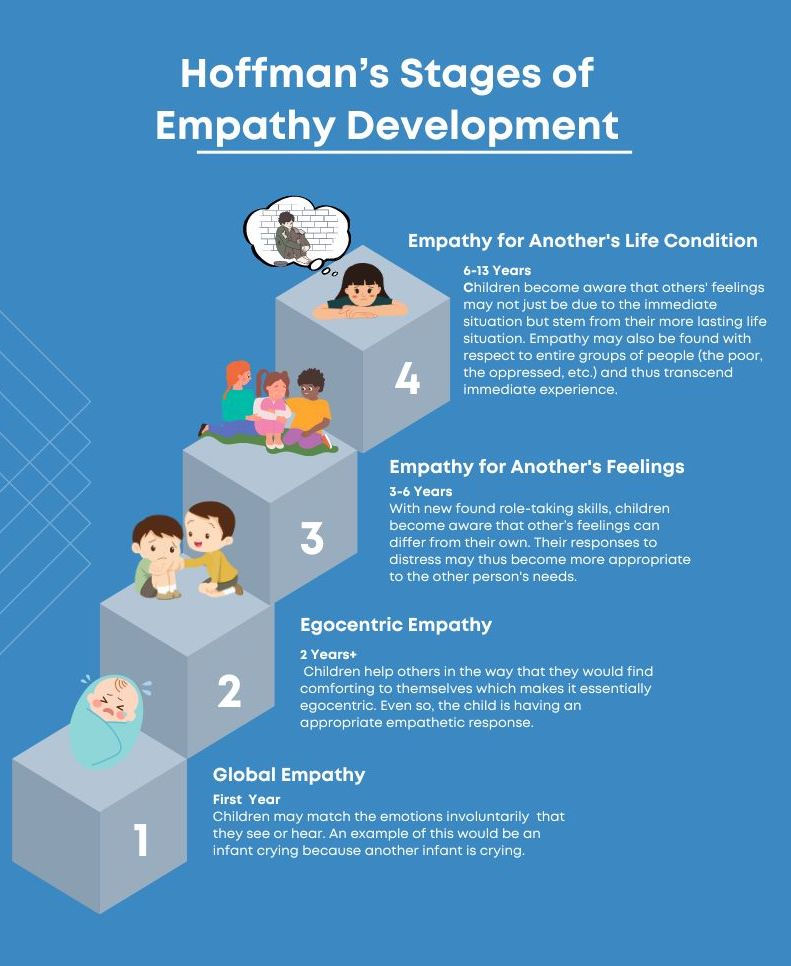
A key piece of the moral development puzzle was empathy. Hoffman’s theory states that children start their empathetic development journey in their first year of life and continue to progress through the stages until they reach the ability to empathize with another person’s life situation and realize their distress is not only because of something immediate but a complex combination of life circumstances and conditions. Here is an image with a brief overview of these stages.
So how does this help us to create positive learning environments for our young learners? Well first of all we can see that in order to help our students succeed through SEL, it is going to take more than just teaching them to obey for reward and resist punishment. While this is a time tested, tried and true, effective way to create a safe learning environment, it is selling our students short. Countless times I have underestimated my children and my students and am constantly blown away by what they are actually capable of.
Let’s go back to little Johnny and Sally from our theoretical example before. Through the lens of moral development, Johnny chooses the morally right decision to not steal Sally’s snack because he doesn’t want to get in trouble for stealing and breaking the rules of the school and he is acting out of self-interest to not lose his recess time.
Through the lens of moral development, Sally is motivated by the reward of recognition and candy to act responsibly by picking up trash from the playground. But what if Johnny and Sally could be internally motivated by the love and care in their hearts and minds that they experience through empathy for others?
Through the lens of empathy, Johnny resists the temptation to steal Sally’s snack from her because he thinks about how Sally would feel sad and hungry if he did that, and he cares about his friend Sally and doesn’t want her to feel bad. Through the lens of empathy, Sally picks up the trash because she wants to care for the earth and help keep a clean and healthy place for everyone to play and she has learned that everyone has to do their part to keep it that way.
The Key to this difference is one important word: WHY?
If the “why” is simply to not get in trouble or to receive a reward, we are selling our kids short. I suggest that we ask our kids “why?” “Here are the set of rules we follow in our classroom, why do you think we have these?”
I guarantee you will be blown away by their answers.
Application
Okay, so how can we apply all we have learned here to our classroom?
Sandra Crosser, Ph.D from EarlyChildhood News has some suggestions for teaching empathy. The following is an excerpt from her article.
Model Caring Behaviors. One of the best ways to promote empathy is to model empathetic caring. Talk about your feelings for others and how you share their joys, sorrows, pain, or delights. Tell children when you are excited for them or when you feel sorry that they are unhappy.
Name Emotions. Help children give names to their emotions. Most preschoolers can use the terms happy and sad, but are at a loss to describe their emotions precisely. Introduce feeling words such as lonely, frustrated, frightened, joyful, shocked, proud, discouraged, hopeful, unwanted, contented, anxious, or delighted as you read about story characters or simply live through daily events.
Interpret Emotions. As a circle time activity, invite children to "read" or interpret the emotions in the faces of people in large photographs or magazine pictures. Then ask, "Why do you think the girl feels surprised?" and "What could have happened to make the man look so discouraged?"
Role Play Helpful Behaviors. Dramatize stories about specific helpful acts. By discussing and playing out how to help, children learn skills and gain insights into appropriate helping. At the same time, they learn to take different perspectives.
Be Supportive. Maintain a warm, supportive relationship with children and set realistically high standards consistent with the developmental levels of the children. Teach Conflict Resolution. When a child does something wrong to another child, first demonstrate and verbalize empathetic care for the victim. Then point out to the perpetrator how her acts are related to the victim's feelings. By making the child aware of the consequences of her actions you help the preschooler become aware of the inner feelings of others. When the child understands the reasons for rules, she tends to view the world as a more positive, consistent, and meaningful place (Staub, 1995). Finally, reason with the child and help her think of appropriate alternative behaviors that might be used next time.


Comments